

Contents
Trade negotiations are the bargaining process through which countries decide the rules of international trade. These negotiations decide how much market access will be given, how much protection domestic industries can keep, how disputes will be settled, and how countries will cooperate when trade becomes politically sensitive.
Regional or preferential arrangements where members reduce trade barriers among themselves. The depth of integration may be shallow or very deep.
The post-war framework that mainly governed trade in goods and encouraged tariff reduction through trade rounds.
The formal global institution that administers trade agreements covering goods, services and intellectual property.
In theory, countries can simply allow free trade and let buyers and sellers decide. In reality, every country has domestic producers, farmers, workers, exporters, importers, consumers and strategic sectors. These groups do not benefit equally from trade. Therefore, governments negotiate carefully instead of opening markets blindly.
Trade negotiations are formal discussions between countries to decide trade concessions, obligations, protections, rules and dispute-settlement arrangements.
A country may want lower tariffs for its exports, but at the same time it may not want foreign goods to flood its own domestic market. This is the basic tension in trade negotiations. One side asks for market access; the other side asks for protection, safeguards or longer adjustment time.
Why the Topic Has Become More Relevant
- Global supply chains are interconnected — A tariff or restriction in one country can disturb production in another country.
- Countries want export opportunities — Exporters need predictable rules, lower duties and easier standards in foreign markets.
- Domestic sectors demand protection — Farmers, small manufacturers and labour-intensive sectors often fear import pressure.
- Services and intellectual property matter more now — Modern trade is not only about goods; it also includes software, data, patents, brands and professional services.
- Geopolitics affects trade — US-China tensions, supply-chain diversification, carbon border measures and technology restrictions show that trade policy is also strategic policy.
An RTA is an agreement between two or more governments that reduces trade barriers among the members and defines the trade rules applicable to them.
The word “regional” can be misleading. The countries need not always be neighbours. What matters is that the members give each other some preferential trade treatment which is not automatically available to outsiders.
RTAs are popular because multilateral negotiations involving many countries are slow. If 160-plus countries are negotiating together, agreement becomes difficult. A smaller group of countries can move faster and design rules suitable to their own interests.
The easiest way to remember RTAs is to arrange them by depth. The deeper the agreement, the more freedom members give to goods, services, capital, labour and policy coordination.
One country grants trade benefits to another country without requiring equivalent concessions. This is often used to support exports from developing countries.
Two countries, two blocs, or one country and one bloc negotiate trade rules between themselves. The agreement may cover goods, services, investment or selected sectors.
Members give each other lower duties or better access than outsiders. The preference is reciprocal and limited to members.
A group of countries acts together in trade matters. It may involve free trade among members and a coordinated external approach.
Members remove tariffs and quotas among themselves, but each member keeps its own tariff policy against non-members.
Members remove internal trade barriers and follow a common external tariff against non-members.
A customs union plus freer movement of labour, capital and other productive resources among members.
The deepest form: common market plus common currency and stronger coordination of macroeconomic policies.
High-Probability Exam Distinction
| Agreement Type | Internal Barriers | External Tariff | Factor Movement | Recall Line |
|---|---|---|---|---|
| Free Trade Area | Removed among members | Each country decides separately | Not necessarily free | Internal free trade, external independence |
| Customs Union | Removed among members | Common external tariff | Not necessarily free | FTA plus common external tariff |
| Common Market | Removed among members | Common external approach | Labour and capital move more freely | Customs union plus factor mobility |
| Economic & Monetary Union | Highly integrated | Coordinated | High mobility | Common market plus common currency and policy coordination |
This is the most useful way to remember regional trade agreements. Do not study the forms as separate boxes. See them as a ladder. At every higher stage, member countries add one more level of cooperation. Trade becomes freer, but national policy independence reduces.
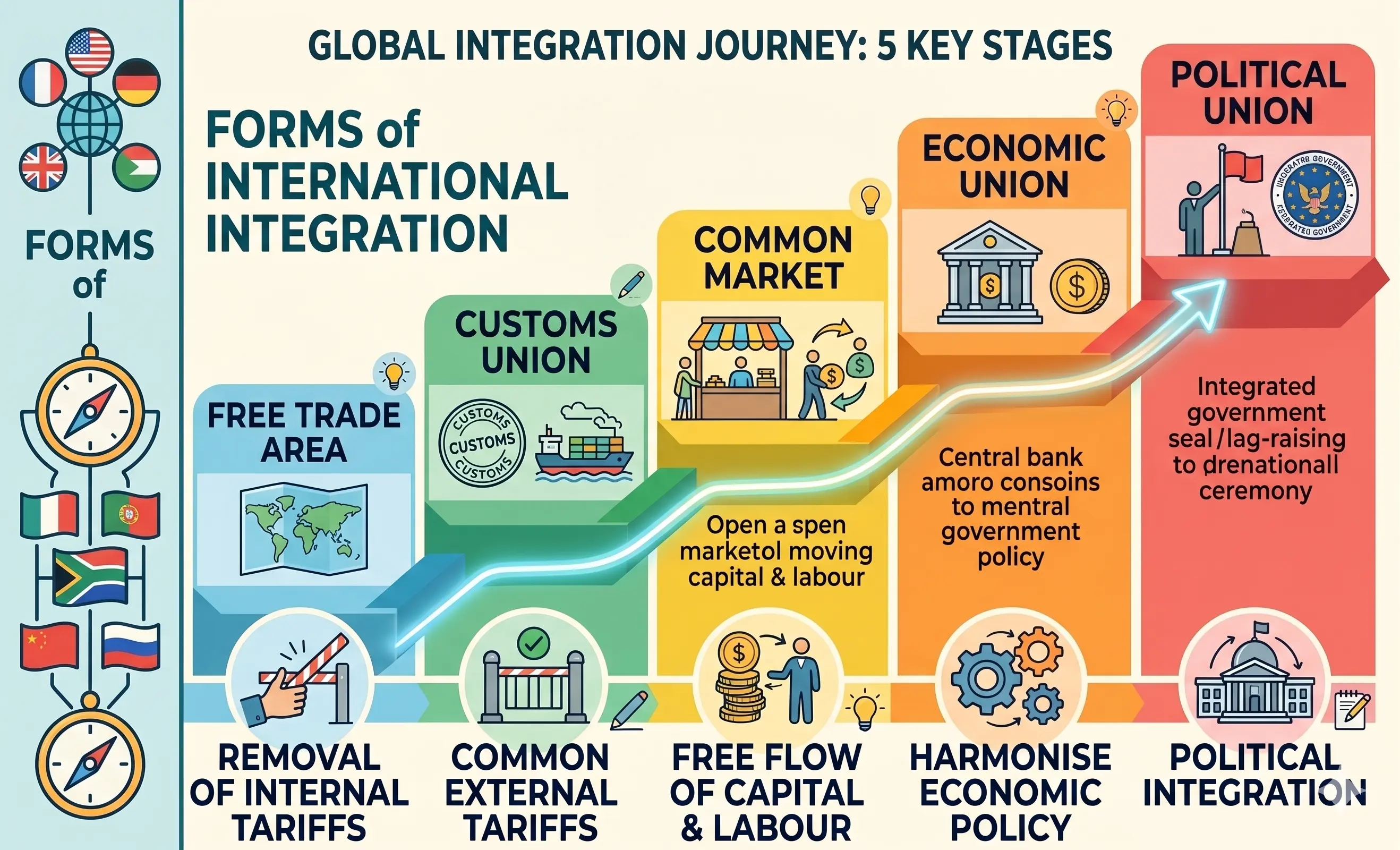
In a Free Trade Area, member countries remove tariffs and quota barriers among themselves. Goods can move more freely within the group. However, each member keeps its own tariff policy against non-members.
Simple recall: members trade freely with each other, but they remain independent against outsiders.
A Customs Union goes one step beyond an FTA. Members not only remove internal trade barriers, they also apply a common external tariff to imports from non-member countries.
Simple recall: outsiders face the same tariff whichever member-country they enter through.
A Common Market includes the features of a customs union and also allows freer movement of factors of production such as labour and capital. This means workers, investors and firms can move more easily within the integrated area.
Simple recall: not only goods move; people, money and productive resources also move more freely.
An Economic and Monetary Union goes beyond a common market. Members coordinate major economic policies and may adopt a common currency. This requires stronger discipline because monetary policy, fiscal priorities, inflation control and exchange-rate issues become connected.
Simple recall: members do not only trade together; they start managing the economy together.
Political Union is the deepest stage. Economic integration moves towards shared political authority, common institutions and coordinated governance. This is much harder than trade liberalisation because it touches sovereignty directly.
Simple recall: trade integration becomes governance integration.
The Full Progression in One Memory Chain
| Stage | Main Freedom | Policy Independence | Best Recall Example |
|---|---|---|---|
| Free Trade Area | Goods move with lower internal barriers | High, because each member keeps external tariff power | India-UAE CEPA / ASEAN-India FTA logic |
| Customs Union | Goods move internally and outsiders face common tariff | Lower, because external tariff policy is shared | EU Customs Union |
| Common Market | Goods, labour and capital move more freely | Lower still, because factor markets need harmonisation | European Single Market logic |
| Economic Union | Markets and macroeconomic policies become coordinated | Much lower, especially with common currency | Eurozone |
| Political Union | Economic and political decision-making integrate | Lowest, because sovereignty is shared | Closest direction seen in deeper EU integration |
GATT was the multilateral framework that governed trade in goods and encouraged countries to reduce trade barriers through negotiations.
GATT emerged in the post-World War II period when countries wanted a more stable trading system. The basic idea was simple: avoid destructive protectionism, reduce tariffs through negotiations, and create predictable rules for trade in goods.
For many decades, GATT helped expand international trade. Countries negotiated in rounds and gradually lowered barriers. However, the world economy changed. Services, intellectual property, investment and complex supply chains became important. GATT was mainly built around goods, so it could not fully handle the new trade reality.
Why GATT Became Inadequate
- Too narrow — It focused mainly on trade in goods, while services and intellectual property became important.
- Weak institutional structure — It was not a full global organization with strong administrative machinery.
- Weak dispute settlement — The system was slower and less effective than what countries later expected.
- Agriculture remained difficult — Developed and developing countries disagreed sharply on farm support and market access.
- Globalisation expanded — International investment and supply chains required wider rules.
- Ambiguities were exploited — Countries could use loopholes and unclear rules to protect domestic interests.
The Uruguay Round was the most consequential trade round because it moved the world trading system from the older GATT framework to the more comprehensive WTO framework. It began in 1986 at Punta del Este in Uruguay and concluded after long negotiations. The final agreement was signed in 1994 and the WTO came into existence in 1995.
Why Uruguay Round Was Important
It covered tariffs, non-tariff barriers, agriculture, textiles, services, intellectual property, investment measures, subsidies, safeguards and dispute settlement.
Agriculture was one of the hardest areas because countries disagreed on subsidies, support prices and market access.
The greatest outcome was the establishment of a formal institution with broader scope and stronger rules than GATT.
The WTO is the global organization dealing with trade rules between nations, built around agreements negotiated and accepted by member governments.
The WTO is not simply a free-trade club. It is a rule-making, monitoring, negotiating and dispute-settlement institution. Its aim is to make trade smoother, fairer, more predictable and less arbitrary.
Six Core Objectives of WTO
- Set and enforce trade rules — Countries need common rules to avoid arbitrary restrictions.
- Provide a forum for negotiations — Members negotiate further liberalisation and rule changes.
- Resolve trade disputes — Members can challenge measures they consider inconsistent with WTO rules.
- Improve transparency — Trade policies should be known, notified and reviewable.
- Cooperate with other institutions — WTO interacts with global economic and technical bodies.
- Support developing countries — Technical assistance and flexibility help developing economies adjust.
The WTO is supported by a Secretariat in Geneva headed by a Director-General. Its decision-making system can be understood in three broad levels.
| Level | Role | Student Recall |
|---|---|---|
| Ministerial Conference | Top-level body that can decide on matters under WTO agreements. | Highest authority |
| General Council | Meets regularly and also functions for dispute settlement and trade policy review. | Working centre |
| Goods, Services and TRIPS Councils | Supervise implementation in their specific areas. | Three subject pillars |
| Committees and Working Groups | Handle specialised areas such as agriculture, environment, development and regional trade agreements. | Detailed technical work |
The WTO works on a set of basic principles. These principles create discipline in global trade by limiting arbitrary discrimination and encouraging predictability.
If a WTO member gives a trade advantage to one member, it should normally extend the same advantage to all WTO members. The idea is equal treatment among trading partners.
Once imported goods, services or intellectual property enter the domestic market, they should not be treated worse than domestic equivalents.
Trade barriers are reduced gradually through negotiation. Developing countries usually get more time to adjust.
Countries bind commitments so businesses know the maximum tariff or rule position and can plan investment and trade.
Trade laws, rules and policy changes should be public, notified and reviewable so that countries are not surprised by hidden barriers.
WTO does not ban all protection. It allows action against unfair practices such as dumping and trade-distorting subsidies, subject to rules.
MFN vs National Treatment
| Basis | MFN | National Treatment |
|---|---|---|
| Comparison | One foreign country versus another foreign country | Foreign product versus domestic product |
| Timing | Applies when trade advantage is granted to a trading partner | Applies after the import has entered the domestic market |
| Core Idea | Do not discriminate among WTO members | Do not treat imported goods worse than local goods after entry |
| Example | If tariff concession is given to one WTO member, it normally extends to others unless an exception applies. | Imported mobile phones should not face discriminatory internal taxes compared with similar domestic phones after customs clearance. |
WTO agreements cover goods, services and intellectual property. Students often find the list lengthy. The best method is to group them by purpose instead of memorising them as one flat list.
- Agriculture
- Textiles and Clothing
- Import Licensing
- Rules of Origin
- Customs Valuation
- SPS Measures
- Technical Barriers to Trade
- Pre-shipment Inspection
- Anti-Dumping
- Subsidies and Countervailing Measures
- Safeguards
- GATS for services
- TRIPS for intellectual property
- TRIMs for investment measures
Important WTO Agreements Explained
| Agreement | What It Tries to Solve | Simple Example |
|---|---|---|
| Agriculture | Disciplines market access, domestic support and export subsidies in farm trade. | Disputes over farm subsidies and public stockholding show why agriculture is politically sensitive. |
| SPS Measures | Prevents health and plant/animal safety rules from becoming disguised trade restrictions. | Food imports may be checked for pesticide residue, but the rule should be science-based and not arbitrary. |
| TBT | Prevents technical standards, testing and certification from becoming unnecessary trade barriers. | Standards for electrical goods or auto parts should protect safety without unfairly blocking imports. |
| TRIMs | Restricts investment conditions inconsistent with national treatment and quantitative restriction rules. | A country cannot freely impose local-content or trade-balancing conditions that violate agreed disciplines. |
| Anti-Dumping | Allows action when foreign producers sell at unfairly low prices and injure domestic industry. | India frequently investigates dumping complaints in sectors like chemicals, steel and consumer goods. |
| Customs Valuation | Creates more reliable and consistent valuation rules for imports. | Import duty should not depend on arbitrary customs valuation. |
| GATS | Provides rules for international trade in services. | IT services, consulting, finance, education and professional services come under the wider logic of services trade. |
| TRIPS | Sets rules on intellectual property rights linked to trade. | Patents, trademarks, copyright and geographical indications become trade issues. |
| DSU | Provides the dispute settlement mechanism. | Members can challenge measures they believe violate WTO obligations. |
| TPRM | Reviews member trade policies to promote transparency. | Countries’ trade policies are periodically examined and discussed. |
The Doha Round, formally called the Doha Development Agenda, was launched in 2001 at the WTO’s Fourth Ministerial Conference in Doha. It was intended to be a development-focused trade round, especially addressing the concerns of developing countries.
The agenda covered agriculture, services, non-agricultural market access, environment, intellectual property and other rule-related issues. Agriculture became the most difficult and politically sensitive area because developed and developing countries had sharply different interests.
Often demand more market access in developing countries and stronger rules in services, investment and intellectual property.
Demand reduction of farm subsidies in rich countries, better market access for their exports and flexibility to protect vulnerable sectors.
The WTO created a stronger rule-based system, but its functioning has not been free from criticism. Many concerns arise because countries are unequal in economic strength, bargaining power and adjustment capacity.
Multilateral negotiations are difficult because all members must reconcile many conflicting interests.
The rise of bilateral and regional agreements may weaken the centrality of the multilateral system.
Many sensitive areas remain protected through tariffs, standards, subsidies or complicated rules.
Developed and developing countries often disagree on agriculture, subsidies, services, intellectual property and policy space.
Higher tariffs on processed goods discourage developing countries from moving up the value chain.
Developing countries may struggle to implement complex commitments and face domestic disruption from competition.
| Concept | Best Recall Line |
|---|---|
| Trade Negotiation | Bargaining between countries over market access, protection, obligations and rules. |
| RTA | Members reduce trade barriers among themselves, usually giving preferential treatment. |
| FTA | Internal tariffs removed; each member keeps its own external tariff. |
| Customs Union | FTA plus common external tariff. |
| Common Market | Customs union plus movement of labour and capital. |
| Economic Union | Common market plus deeper policy and currency coordination. |
| GATT | Old framework mainly for trade in goods. |
| Uruguay Round | Most consequential round; led to WTO. |
| WTO | Global institution for trade rules covering goods, services and intellectual property. |
| MFN | Do not discriminate among WTO members. |
| National Treatment | After entry, imported goods should not be treated worse than local goods. |
| GATS | Agreement on trade in services. |
| TRIPS | Agreement on trade-related intellectual property rights. |
| TRIMs | Agreement dealing with trade-related investment measures. |
| Doha Round | Development-focused round launched in 2001; agriculture remains a key issue. |
GATT mainly dealt with goods. WTO covers goods, services and intellectual property through a formal institutional structure.
MFN compares foreign countries with each other. National treatment compares imported and domestic products after entry.
FTA has separate external tariffs. Customs union has common external tariff.
Uruguay Round created WTO. Doha Round is the development agenda associated with unresolved negotiation difficulties.